Showing posts with label Myanmar Yangon Mandalay Bagan Lake Inle Taunggyi Nyaung Shwe Kakku. Show all posts

Thursday, January 03, 2019

MINGALABAR - MYANMAR IS ANOTHER JEWEL IN OUR BACKYARD

The most iconic feature in Yangon is Shwedagon Pagoda. It looks so tranquil reflected in the waters of this lake. I spent eight days discovering this "diamond in my backyard" (Myanmar).

The pagoda towers over a Yangon that is awakening with the morning sun.

At ground level. Myanmar people are extremely proud that out of relative poverty wealth can emerge. Many have contributed to purchasing some 60 tons of gold which have been "showered" on the stupa, unlike other pagodas which have gold paper stuck on them.Built some 2,600 years ago, it is the oldest pagoda in Myanmar.

Many valuable and important relics are stored within its extensive compounds. I dare not hassle a guess for the value of this jade Buddha statue which weighs many tons.
This was called Scott Market but renamed after the late Gen Aung San who obtained independence from the British and is the father of the current de facto leader Daw Aung San Suu Kyi.

The market sells a lot of stuff which to me appeal more to women. I would equate it to Ben Thanh Market in Ho Chi Min City and the Central Market of Phnom Penh.

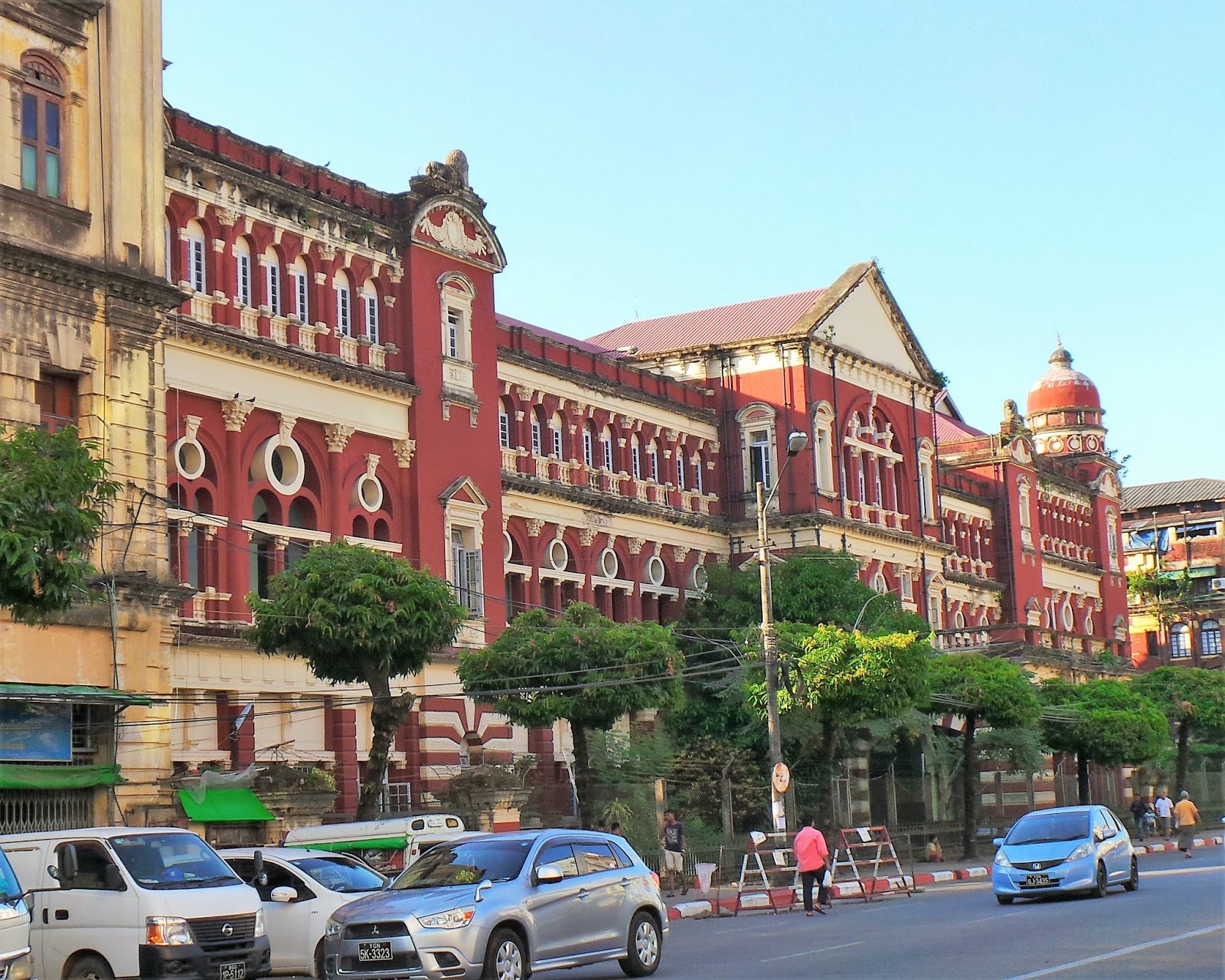
The High Court Building is a stark reminder of British Colonial architecture. The British Colonial Masters left a large legacy of buildings which Myanmar architects and urban planners are trying to preserve.

A contrast of old and new.

Lunch in a Nasi Briyani restaurant. Some viewers may recognise Philip Gwee Peng Hong who is semi-retired there and joined us for lunch.

Nasi Briyani a la Yangon. It comes with a layer of bread which is broken open and the contents taken out for consumption in a separate utensil.

Turbo prop planes like this serve the internal fight market well as the road network leaves much to be desired.

Heho (pronounced Hei-ho) Airport is small and basic. Flight details are displayed on carried boards or on the walls while announcements are made by loudhailers. Morning departure flights are prone to delays as it's usually foggy.

Salamuni Temple in Taunggyi which formed part of a loop for us to travel from Heho Airport to Nyaung Shwe, the town to access Inle Lake. Taunggyi is somewhat similar in characteristics to Cameron Highland.

22-23 November are national holidays in Myanmar. In Taunggyi, a big balloon festival is held. Participants bring balloons which are filled with hot air and then released, some with fireworks attached to them. It's like a competition to see whose balloon is bigger and/or can fly higher. There was an incident there on 22 or 23 Nov when a balloon took off but did not attain the required height and came crashing down on fire plus setting off the fireworks. A great number of spectators died from burns and many were injured. It's often that such incidents happen during the festival. Notwithstanding, the residents insist that the festival will carry on as it's a long standing religious tradition.
The festival mood is abetted by stalls selling food like savoury fried fritters, cold drinks, beer and other stuff. Loud music is also played by mobile "sound ministries"

This is where the balloons are prepared for flight. They may be flown in the late afternoon and at night.

2,200 Stupas of Kakku.

A waitress in her traditional Pa O costume. Pa O is the biggest tribal denomination in Shan State.

Khun Myo, boss of the company which made our tour possible, hosted us to dinner at his house. He is a scholar, accomplished chef, skilled photographer (who leads photography tours himself) and successful entrepreneur doing home stays on Lake Inle too. He cooked the delicious Shan cuisine meal himself. Khun is in the background with his lovely family.

These were only the starters to pair with Myanmar-produced wine.

Wednesday, January 02, 2019

MINGALABAR - MYANMAR IS ANOTHER JEWEL IN OUR BACKYARD.


 Nyaung Shwe is the town from which one gets to Inle (pronounced "Inlay") Lake, one of the larger inland lakes but perhaps the most interesting and one which brings in much tourist revenue. We boarded long shaft propeller teak boats to visit sites in the lake.

Such are the long boats made of teak wood which are akin to water taxis as boats are the main means of lake transportation. For foreigners, each boat will take four to five pax comfortably; for locals, willing seller willing buyer is applied as regards how many pax are to be taken.

Many cottage industries exist in the lake. This one deals with the production of cheroots.

A mobile market exists; its location is changed each day. In the market, this Pa O tribeswoman sells dried goods.

This is where cooking oil is sold.

Vegetable seller. I love the veggies cause they come from floating farms found in the lake.No need to debate whether they are organic or not.
 
This is like a water taxi stand serving the market.

Silk spinner. Silk production is one of the cottage industries.

She is extracting lotus leaf fibers to make silk. Perhaps, only in Lake Inle is such silk produced and it's the most expensive as many stems are needed to make a thread of silk. It's also very strong and yet supple and won't look crumbled even after being folded.

Inle Lake Heritage is one of the better restaurants here serving delicious Myanmar, Thai and Chinese food.
,
A couple of Burmese cats which were extinct in Myanmar until the owner of Inle Lake Heritage imported a few from overseas. Presently, there are more than 30 cats housed in the Burmese Cat Village sharing the compound of the restaurant.

Teak wood boat workshop.

Hull of a boat being completed. Every piece of wood is painstakingly done by hand.Here a long plank is sawn manually. A completed boat sells for about USD 2,500 to USD 3,000, without propulsion.

Women are employed to make cheroots by hand.

Hpaung Daw U Pagoda - where lake residents gather to worship. In the months of Sep and Oct, they hold a big festival lasting 18 days.

These boatmen literally beat the water to drive fish nearer shore so that they can use long fish traps to catch them.

This tribal "leg rower" fisherman demonstrates how fish are trapped in the long trap using legs only to control and steer the boat.

Proudly showing off  the tilapia he caught.

Singaporeans gingerly"walking the plank" to go for a cruise in the Irrawaddy River.

MINGALABAR - MYANMAR IS ANOTHER JEWEL IN OUR BACKYARD

The Me Nu Ok Kaung built by Queen Me Nu in 1818 as the residence of the Royal Abbott. Also known as The Maha Aung Mye Bonzan Monastery, it is a fine example of Burmese monastery architecture during the Konbaung Dynasty.

A fair Myanmar maiden posing in one of the stuccoed windows of the monastery.

And this monk also came to admire the fine architecture armed with his SLR camera.

The renowned U Bein Bridge of Mandalay. It took two years to build and was completed in 1851. Constructed of teak wood, it is 1.2 km long and may take a half hour to cross during festive times.

People waiting to catch the sunset from the bridge.


The uncompleted Mingun Pahtodawgyi (pagoda) from the river Irrawaddy.

Front of the huge unfinished pagoda.

Delicious looking hawker fare, better to eat with caution to avoid "tourist diarrhoea".

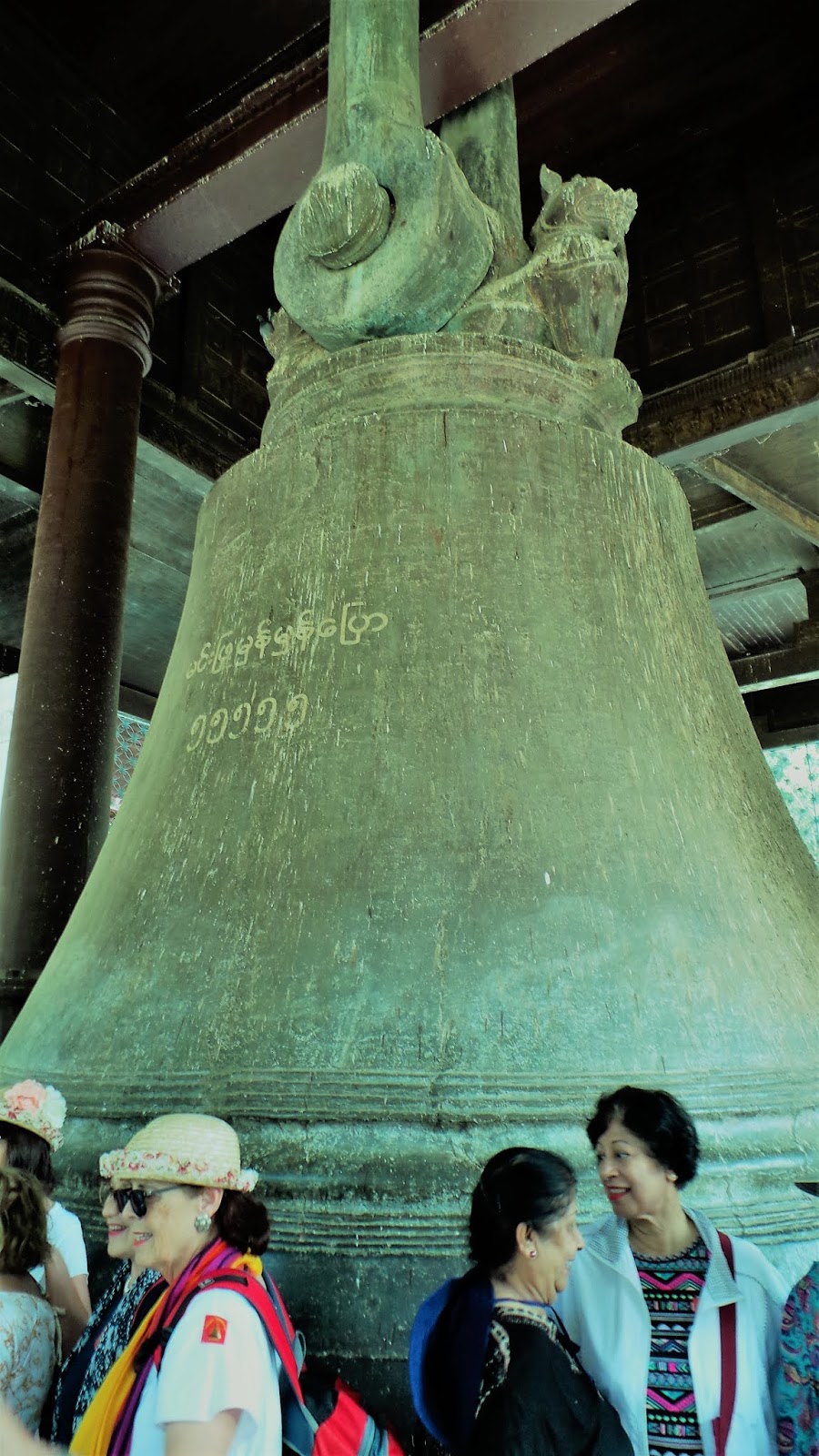
At 90 tonnes, this bronze bell is said to be the World's biggest.

Oil paintings of what are seemingly past times of elderly women.

Also found on Mingun is the Hsinbyume Pagoda striking for its white colour.

The "Biggest Book" in the World.

The Biggest Book in the World is made up of cubicles like the ones shown. Each cubicle contains a stone tablet engraved on both sides with Buddhist text.

The groupwith the tour guide's son outside the (old) Palace Walls of Mandalay.